Let’s talk a bit about Bitcoin
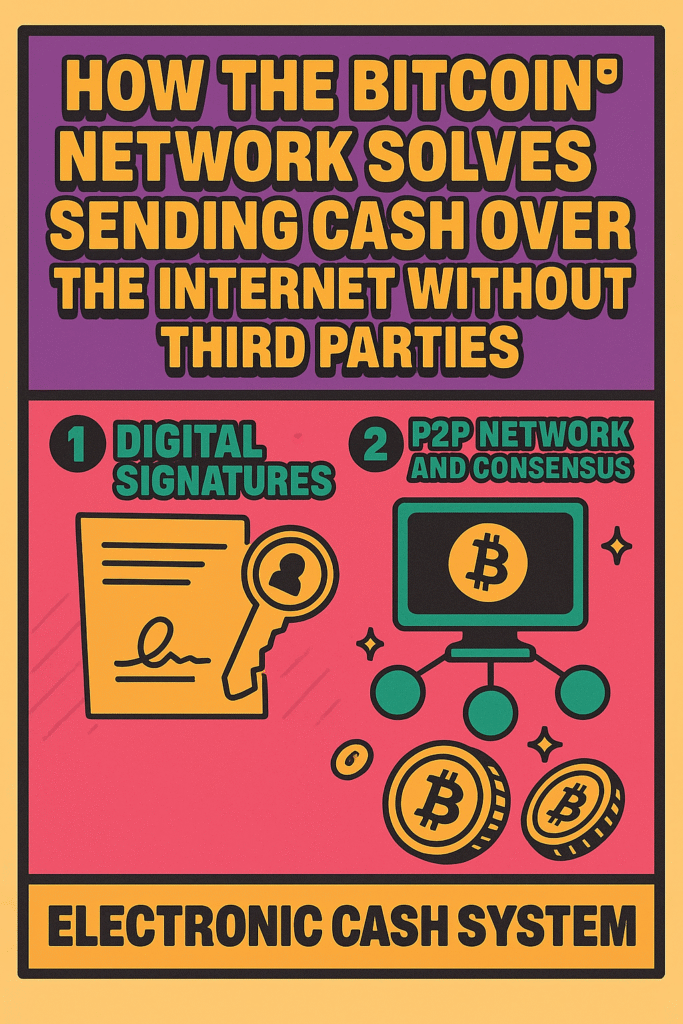
The Bitcoin network solves a huge problem: sending cash over the internet without the need for third parties. And how does it do that?
1. Digital Signatures
2. The P2P Network and Its Consensus
Digital Signatures: This is where digital signatures (public key and private key) come in. A signature guarantees that only the person who owns the private key, which proves that the cash belongs to them, can authorize a payment.
But this alone is not enough. With only digital signatures, we would still need a trusted third party to verify everything and prevent someone from spending the same cash twice. Today, that third party is the banks: they also use digital signatures, but they are the ones who validate everything.
So yes, we can have “electronic cash,” but always depending on a third party like banks. That means we would never truly be independent, just like what happens with physical cash.
The P2P Network and Consensus: This is where Bitcoin gets brilliant.
The network is peer-to-peer (P2P) and works through consensus. In simple terms: it’s how all the participants in the network (peers) agree on how to build the history of transactions. This history is recorded and accumulated so that anyone joining later can see it. The truth that the network builds over time ends up being accepted by both those who leave and those who arrive.
We no longer need to trust a single person or an institution. We trust the network itself. The longest history (what we know as the longest chain) the one with the most work put into it, holds the truth about the current and past state of all transactions.
What’s most fascinating (and crazy) is that it no longer matters if you or I agree: truth is whatever the network’s longest history says. No more pointless disputes.
That’s why, beyond being just an electronic cash system, thanks to its network effect and the way it has grown since the beginning, Bitcoin unlocked something much bigger: a network of trust without intermediaries.
And all of this runs on a simple structure of incentives and validations. Crazy, right?
When I studied electronic engineering, I was amazed by how something with such a simple function as a transistor could spark an entire technological revolution. I never imagined I would find something similar in my lifetime… That’s why the technology behind Bitcoin fascinates me so deeply. 😅⚡️